
We can have the best EDC in the world - if, at the moment you need to get your hands on it, your equipment is still in your other jeans, sitting on the table, or even “quickly stashed” in a drawer... it becomes useless. This is exactly the kind of detail that makes your EDC lose all its appeal. Not having it when you need it is a waste of time searching.
Forgetting your keys, wallet, phone... there are days when it's not a big deal, but others when it really changes your situation.
In this article, I would like to present a simple preparation routine, almost mechanical. With each change of trousers, all the contents of the pockets are transferred: the old "futal" (or "falzar" to quote the 7th Company) is emptied, then the new trousers are immediately re-equipped. Result: the'EDC remains accessible, ready to use, at any time, without having to think about it or look for it. It’s a small habit, but it makes the whole thing EDC Management on a daily basis, very reliable.
From dirty pants to clean pants. From everyday pants to work pants for Sunday DIY projects. From jeans to shorts for a run. The same principle applies every time: your kit goes wherever you go and is always ready, no matter what you’re doing. Let’s explore together this habit that makes life easier.
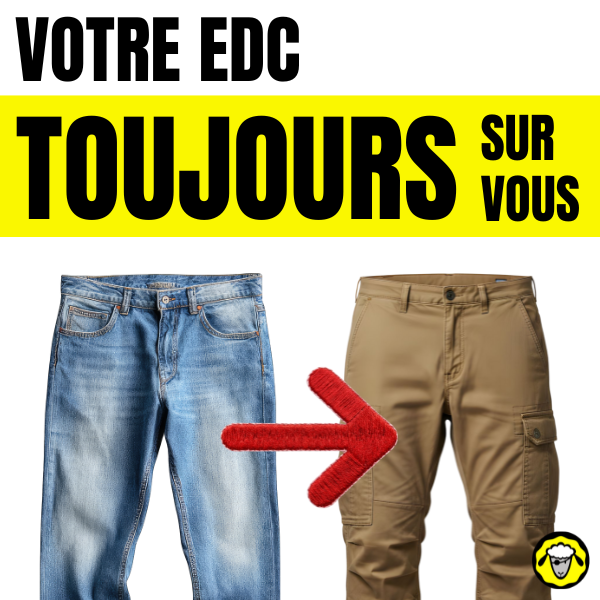
The real subject: pocket logistics, not the “stuff”
We often choose the wrong fight: content comes after logistics.
We often pick the wrong fight. The debate about “what to put in one's EDC”is secondary. The real problem is the logistics. : How to wear your essentials around the clock without any gaps.
The handbag: practical, but not something you carry around with you 24/7
For most women, it's simple: the handbag. Practical. It goes everywhere, no matter the outfit. But it has its limits. In real life, it mostly goes... outside, when we leave the house.
On the other hand, at home, in the garden, in the garage, the bag often ends up placed in a corner. It's in the room, yes, but it's no longer on you. And it can be forgotten...
Saddlebag, fanny pack, backpack: valid solutions depending on one's lifestyle
For many men, a pouch can play the same role: fanny pack, crossbody bag. For others, the’EDC is not only in pockets: it's in a small backpack, carried to work, practical for long days and commutes.
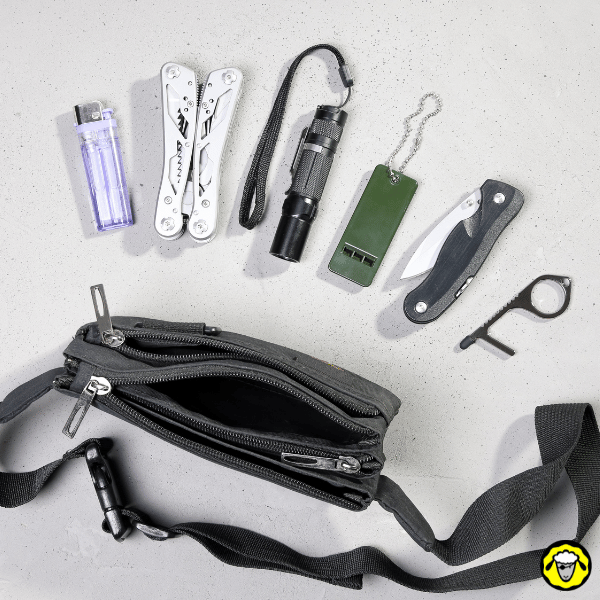
These options are perfectly consistent, and sometimes even essential depending on the context (profession, transportation, specific equipment). But it's not my personal preference, and I know I'm not the only one.
Voyager light: pockets, minimalism, and organization
Many don't want to carry a bag or a satchel. They want to travel light: what fits in pockets is more than enough. On one condition: that it's minimalist and organized.
One EDC In the pockets: the real advantage is continuity
One EDC that fits in the pants pocket, it's a EDC that sticks to the skin.
- It doesn't depend on a bag placed on a chair,
- from a forgotten satchel in the car,
- or a jacket left in the cloakroom, on a chair, or in the entrance.
It's on you because it's in your pants. And that changes everything, because pants are the first “useful” layer we wear 24/7: at work, at home, outside, and yes... even in the bathroom.
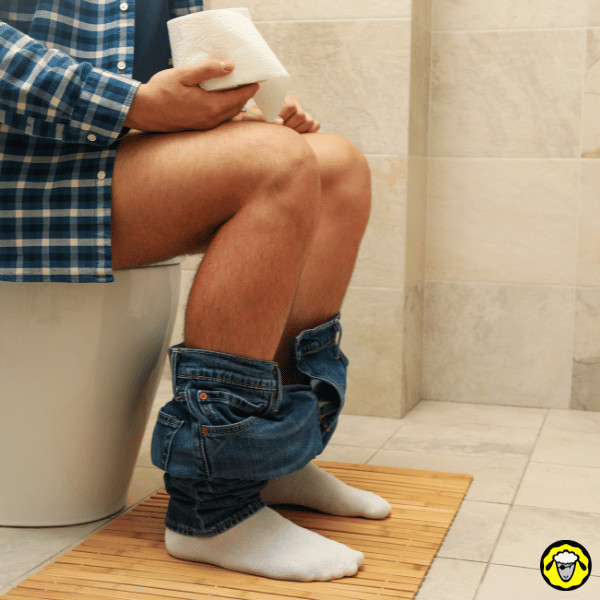
The number one advantage of pockets is therefore the Continuity.
- We can get up,
- Go out for two minutes,
- go to the mailbox,
- pick up a package,
- make a detour through the garden,
- get in the car,
- check out
without ever asking “Did I grab my keys? My wallet? My phone?”. simply because the equipment doesn't leave the body.
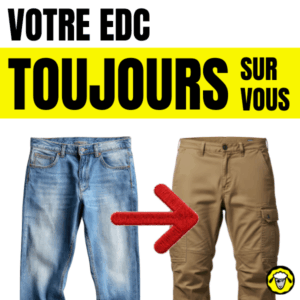
And that's where the “change of pants” makes perfect sense. If your pants are your first line of equipment, then their pockets are your basic organization. The goal is for your EDC to adjust with every change of outfit. When switching from jeans to garden pants, from everyday trousers to sports shorts, or from “clean” to “dirty” pants, cargo transfer it must become a habit every change of clothes.
Why we change pants so often (and why it matters)
We change outfits all the time without even realizing it. A typical day is often: work → home → activity.
Concrete example. You're coming home from work in jeans, already equipped with your EDC. Then you put on a “dirty” pair of pants for gardening. You start clearing brush, pruning, tidying up. And then, the accident: your brother-in-law injures himself with a tool. It's bleeding badly. You have to apply pressure, manage the bleeding, and go to the emergency room.
In the best-case scenario, you transferred everything at the time you changed clothes. So you already have your keys, phone, and wallet on you, in your gardening pants. You're efficient: you start without wasting time, you let a loved one know, you manage. The stress is already there; there's no need to add a treasure hunt.
In the worst-case scenario, your EDC It stayed in the work jeans, placed on the floor in a corner of the house. You have to let go of the situation, run to get the jeans, “empty his pockets,” transfer into the current pants the essential items (keys, phone, wallet), all with rising adrenaline and urgency. A few minutes on a normal day is nothing. In moments like these, it's a long time.
And without going that far, there's the everyday: not having your flashlight or pocketknife handy when you need it, that slows you down and annoys you (at least it does for me). EDC is only useful if it's there, as usual.
Download your free PDF ebooks
15 free guides to choose from pour Boost your resilience.

The transfer of the EDC, concretely
The principle is intentionally basic: when you change your pants, you transfer everything what lives in your pockets.
Not “I'll just grab the keys and my phone.” Not “I'll worry about my wallet later.” You take ALL the contents out of the old pants, you equip the new ones, and the old ones remain empty.
And above all, it creates a mental rule that eliminates time-wasters: if it's not on me, it's in the old pants. So I don't search the whole house. I know.
Monday EDC for example
I'll say it clearly: an EDC is personal.
Everyone has their needs, their constraints, their job, their life.
Mine is only held by me. I'll show it to you as an example but mostly to illustrate the mechanism: carrying useful everyday materials and, above all, knowing how to manage them, 24/7.
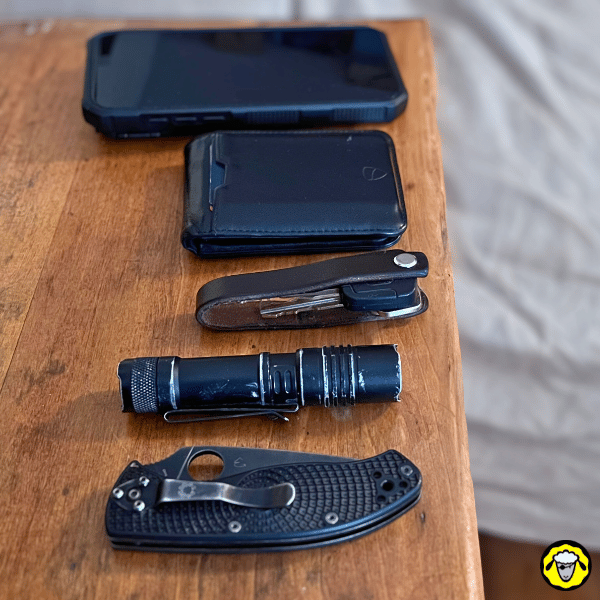
The Everyday Carry (EDC) that has been with me for years, 24/7.
This is the Top 5 never leaves me: flashlight, pocket knife, minimalist wallet, phone, car/house keys.
For those who want to know the model, etc., I talk in detail about what I'm wearing in the EDC gear section of the site. Link below.
Exclusive selection of survival gear
Click on one of the images to access it, then the EDC category.

The flashlight: the most underestimated tool
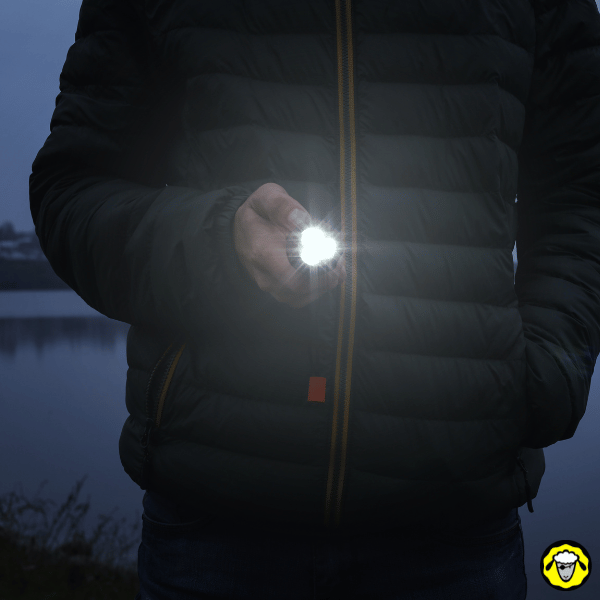
I use it almost every day. I live in the country, no streetlights. Going to the mailbox, finding a screw that rolled under furniture, lighting up under a car seat... It's not “survivalist,” it's just normal life. And all you have to do is carry a flashlight daily to realize how much it simplifies everything.
The folding knife: useful, but to be handled with common sense
I have one, and I use it. It’s not to act like a tough guy; it’s just handy for opening packages (95% for his job). Now, I’d like to remind everyone of an important point regarding France: carrying and transporting Category D weapons (which may include certain knives) is prohibited. without legitimate cause, and appreciation depends on the place, circumstances, and context. The law on knives was tightened in September 2025. It's up to you to act accordingly.
I live in the United States, where the context is different, and the state I live in allows citizens to carry a small folding knife in their pocket. I don't deprive myself of it.
I repeat: an EDC is personal. Adapt yours EDC à your reality and to your constraints.
The wallet: minimalist, or I hate it
I don't like bulky wallets. I aim for functional: a little cash, my license, a credit card, health insurance card, a small emergency cash stash, folded and tucked into one of the card slots, and that's it. The thinner it is, the more you can carry it without thinking about it. Especially if it spends its life in your front pants pocket.
The phone and keys: the two essentials
The phone, today, is the multi-purpose tool. If there were only one object left in my EDC, ...it would be him. And keys are the objects you immediately regret when they're not there. This duo, if lost or misplaced in the house at the wrong time, costs you right away.
Everyone knows that stress: running after your keys. It's already no fun when you're late for an appointment. And it becomes downright critical in case of an emergency. The kind of emergency that often rhymes with:
«Stay put, I'll be right there!»
«Quick, to the hospital!»
«There's a fire!»
«Quick, we can't stay here, let's get out of here!»
«Help, call for emergency services!»
Always within reach, even at night
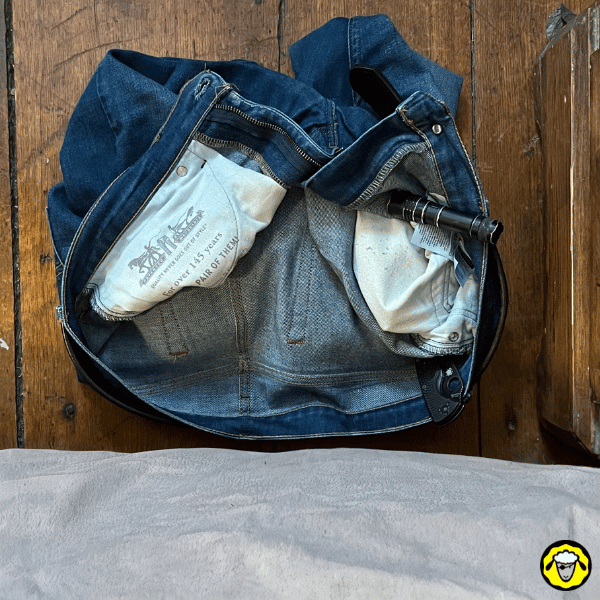
The pants, at the foot of the nightstand for quick access, even in complete darkness.
Finding your lamp in the dark: touch does the work
Even in complete darkness, it's easy to quickly find your flashlight in your pants, which are left at the foot of the bed. You just need to feel around. By touch, you can quickly identify the “hard” areas: the fly, the clip of the knife, the bulk of the wallet, the body of the flashlight. And just finding one of these landmarks is enough to know roughly where your hand is on the pants. From there, it's simple: shift a few centimeters and grab exactly what you want.
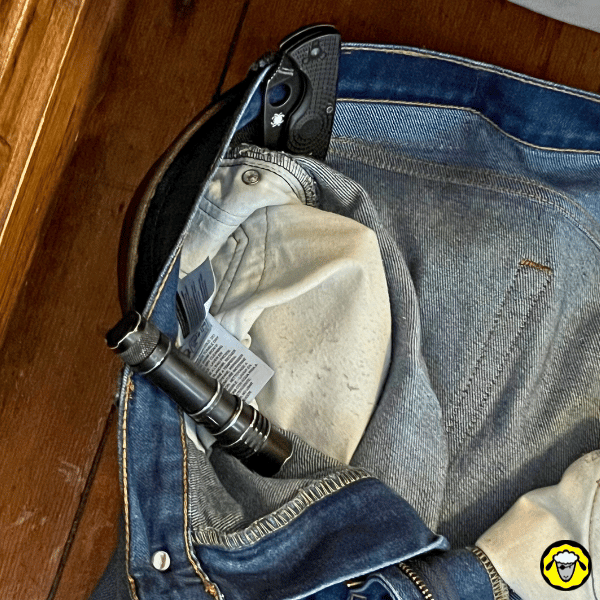
The EDC doesn't leave pockets or belt loops,
apart from the phone charging on the nightstand.
When habit becomes universal: bed, friends, car, tent
When this habit of leaving jeans in the same spot, right next to the bed, becomes systematic — and especially when it's applied all the time — the benefit extends beyond the bedroom. Even when sleeping at friends“ places, on a sofa, in an unfamiliar place, in the back of a car, or in a tent, the logic remains the same: the pants serve as the ”support' for the'EDC, so the lamp remains accessible, even in total darkness.
And the telephone in all of this: useful, but less reliable
Yes, a phone can provide light. But it’s less reliable, because it’s never in the same place: sometimes in a pocket, sometimes charging on the nightstand, sometimes across the room because you’re not at home and you plug it in wherever you can. The flashlight, on the other hand, if it stays in your pants 24/7, is 100% reliable.
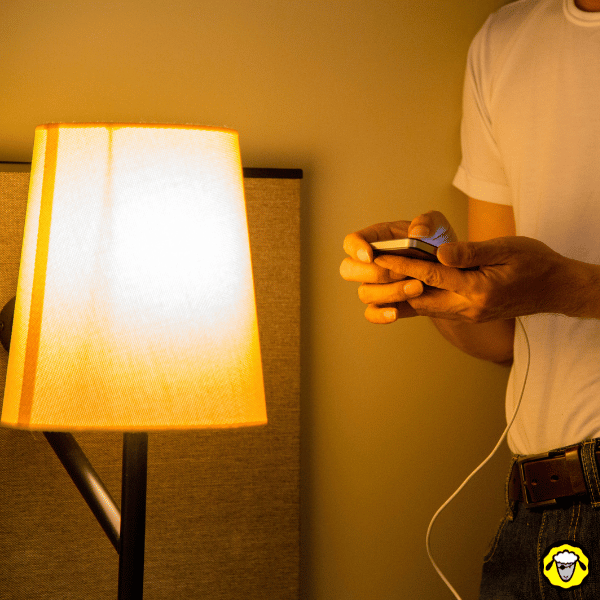
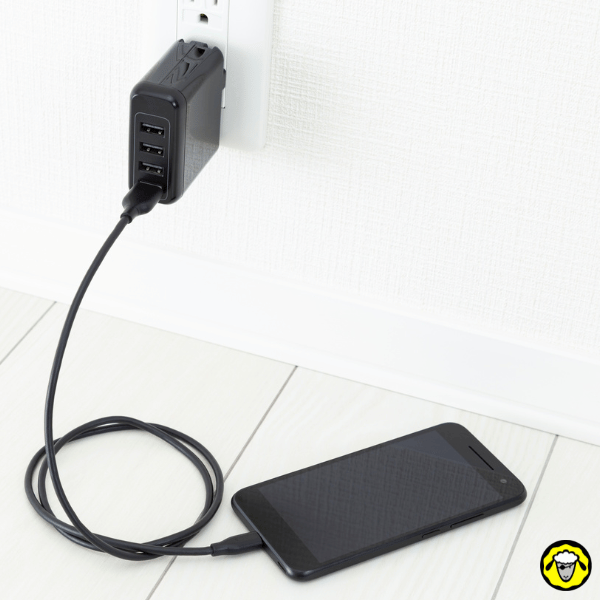
Always the same organization: your hands know before your brain.
A structured system: the foundation that prevents 90% of oversights
This is the most important part. Having a fixed organization is what prevents you from opening a drawer “just in case,” rummaging through all the pockets of a jacket, or making three trips back and forth within the house. When everything has its place, your hands work by themselves, and your brain stops searching.
Finding your place... and never leaving
The goal is simple: find a distribution of pockets that works, and then stick with it. Repetition creates automation. And in stressful situations, when you're tired, or just when your mind is elsewhere, this automation makes the difference.
At my place, it's constant: wallet in the front right, phone in the front left, keys in the front right, next to the wallet.
Knife: discreet, accessible, low profile
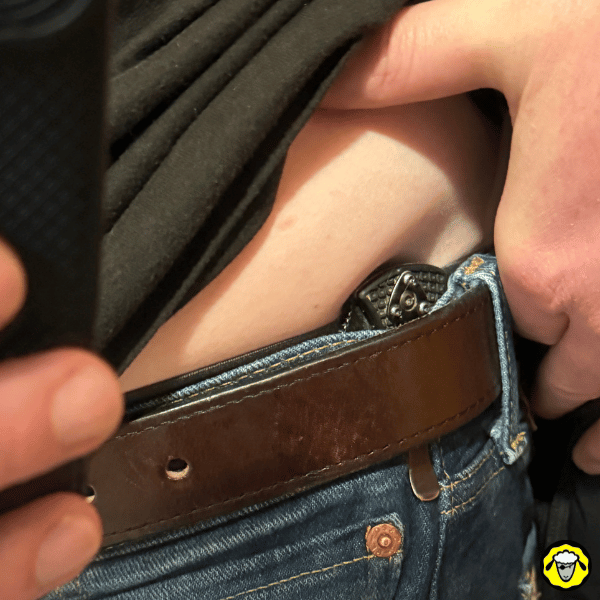
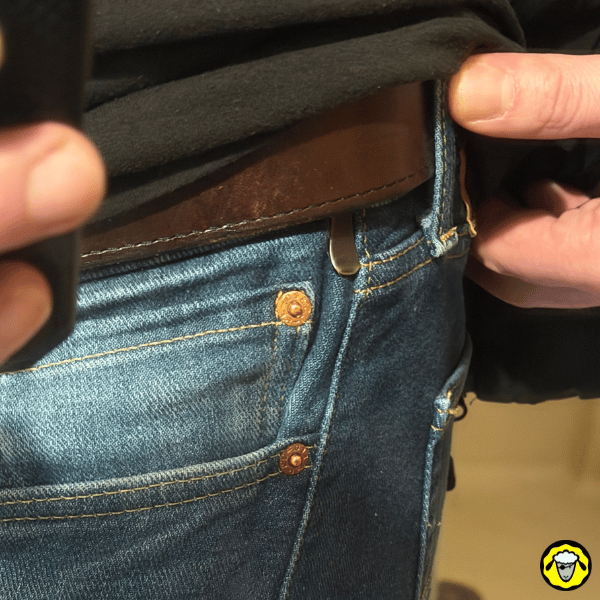
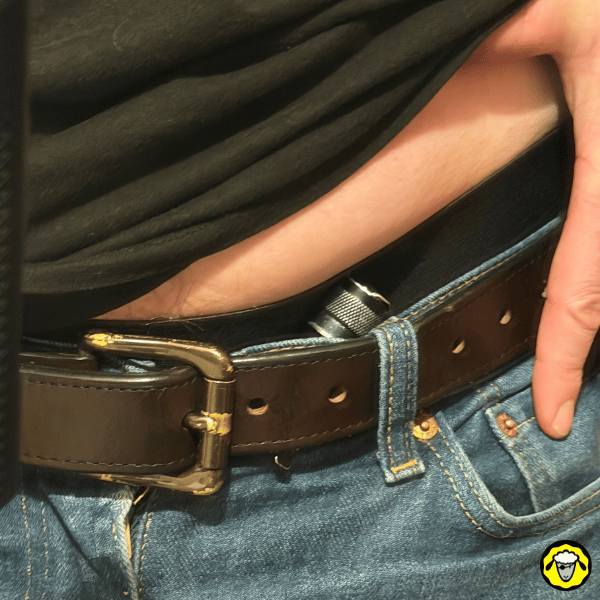
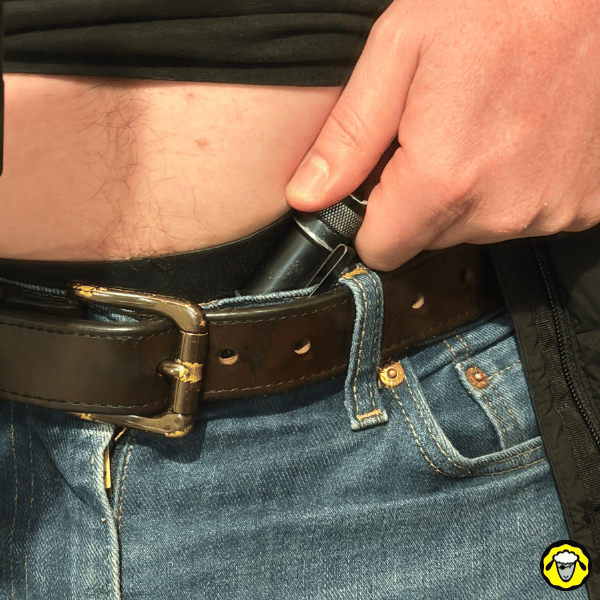
The knife, on the other hand, is clipped inside the belt (inside the waistband), on the right hip. It's discreet but accessible, and above all very low profile. Nothing sticks out of the pocket, and it remains usable without contorting yourself.
Lamp: a “work” setting and a “low profile” setting”
I'll adapt the lamp.
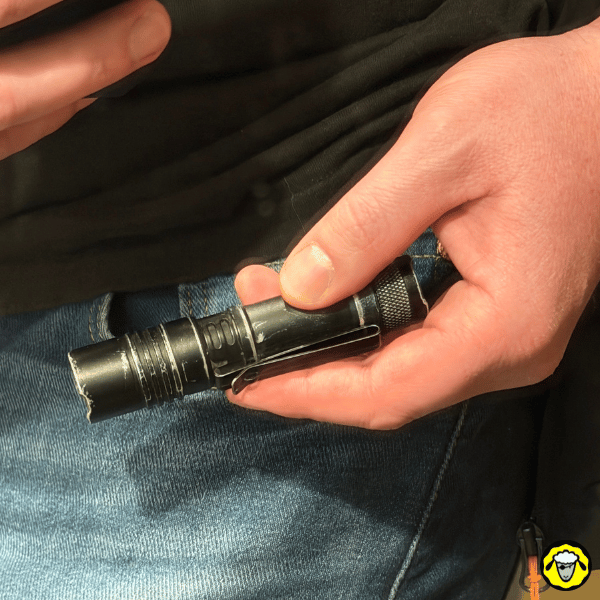
When I'm tinkering and use it often, I want it easily and quickly accessible. So I clip it into my right front pocket. Yes, I know what some people might think: “He's obsessive about his flashlight.” But when you're a DIYer, being able to draw, illuminate, and then reclip without even looking is genuinely practical.
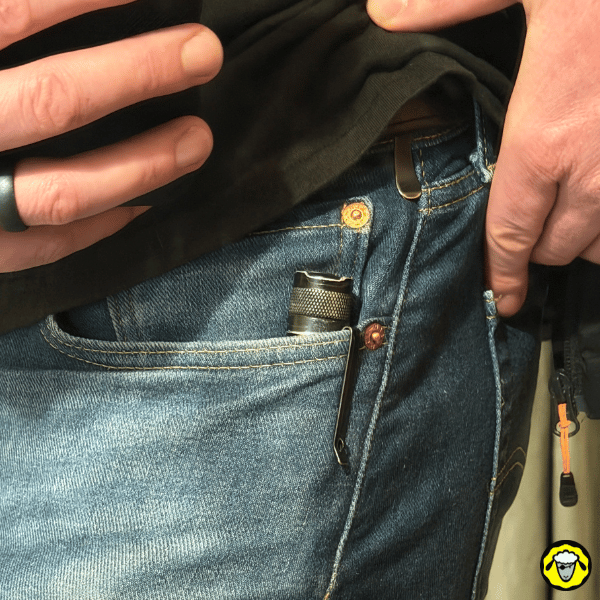
In other situations, if I want to be more discreet, I clip it. inside the belt, at the crease of the groin. It's a bit less comfortable, but it's very low profile. At that point, the flashlight and knife are “hidden”: nothing sticks out of the pockets, no visible clip, nothing visually betrays the side EDC Preparation. Just normal pants, with the essentials already on you.
Back pockets: paper only, nothing important
And the back pockets? I put receipts in them, maybe a tissue, but nothing important. Back pockets are the perfect combo for trouble: less secure (pickpocketing), and very bad for your belongings if you sit on them. I prefer the back to serve as a “paper trash can.”.
The principle before the example
Once again: the goal is to retain the principle, not to copy my organization down to the millimeter. The important thing is to have a fixed, repeated, and reliable logic. That's what makes a EDC _Really useful._.
The discipline that avoids forgetting
The “two-second” trap that becomes an hour
The classic trap is leaving an object down for “two seconds.” Two seconds that turn into an hour. You place the lamp on a shelf “for a moment,” leave the keys on the counter “just there,” put the knife in another pocket “for this one time,” and tell yourself it doesn't count. Except that's precisely how the system breaks down: not all at once, but through small infringements.
Memory is not reliable
The worst part is that it always happens when you don't have "bandwidth." Fatigue, end of the day, children talking at the same time, the phone ringing, errands to run, already thinking about the next day's appointment... Under these conditions, memory is unreliable. It's not a flaw, it's normal. The brain sorts, forgets, and leaves an absurd certainty: “I put it down somewhere, I remember.” Except you don't.
The simple rule that makes an EDC robust
That's why I've set myself a simple, almost strict rule: as soon as I'm done using it, I put it back in its place immediately. Not “in five minutes.” Not “later.” Immediately. Because I know how it ends otherwise. Either the object is lost, because it was placed in a logical spot at the time—a shelf, a piece of furniture, the workbench—but illogical an hour later. Or it has migrated because someone borrowed it. Typically, my wife borrows my lamp and then slips it into her pocket. Nobody did anything wrong. It's just life.
A routine that doesn't depend on being “organized”
A routine of’EDC Reliability doesn't rely on a good memory. It relies on a habit. And a habit needs to be protected: “used = put back”. That's what makes the system robust, even on days when everything goes haywire.
One EDC is not rigid: it is adaptable
I don't believe in the'EDC set in stone. I believe in'EDC coherent.
In winter, for example, my warm jacket becomes an extension of my EDC : beanie in one pocket, gloves in the other, neck warmer in the inside pocket. That way, if I grab this jacket, I know I have a complete "cold kit." I don't have to wonder if I “remembered the gloves.”.
Conversely, when I go for a run, I cut back. I find having my phone in my shorts heavy and cumbersome. A wallet isn't of any interest either. However, some items remain relevant depending on your context and can be securely attached to your belt without jostling. The idea isn't to carry more. The idea is to carry only what makes sense.
Morning or evening change: it doesn't matter, stick to the rule
There are two schools of thought. Those who prepare the next day's trousers the evening before, and those who do the transfer in the morning while getting dressed. And then there's the third, very common case: changing outfits during the day (DIY, gardening, sports).
Honestly, it doesn't matter what school of thought you follow. “Changing your drawers” boils down to one rule: if it's not in your pockets now, it's in the old pants. You keep your gear accessible, or at least located, without having to “search.”.
Conclusion: Make your EDC an asset
The concept of EDC is in the name: Every Day Carry. What we wear every day. And, as often happens, the day it's not with you is precisely the day you miss it. Call it Murphy's Law if you want, but in fact, it's just the mechanics of the unexpected: they rarely happen when everything is calm and organized.
Being organized isn't about being a neat freak. It's about establishing a simple, unobtrusive routine that makes everyday life smoother. And if things go wrong—an accident in the garden, a hurried departure, a call that requires you to leave immediately—there's no need to run around the house to gather your things. Your keys, phone, wallet, flashlight... they're already on you, in the right place.
And you just have to look at how the pros do it when they can't afford to forget. A firefighter doesn't leave “half-equipped.” An ambulance driver doesn't say, “I must have left my gloves in the other pants.” A craftsman responding to an emergency doesn't spend ten minutes looking for where they put their tool. In these professions, critical equipment is placed, organized, and systematically put back in its place because the cost of an error is immediate.
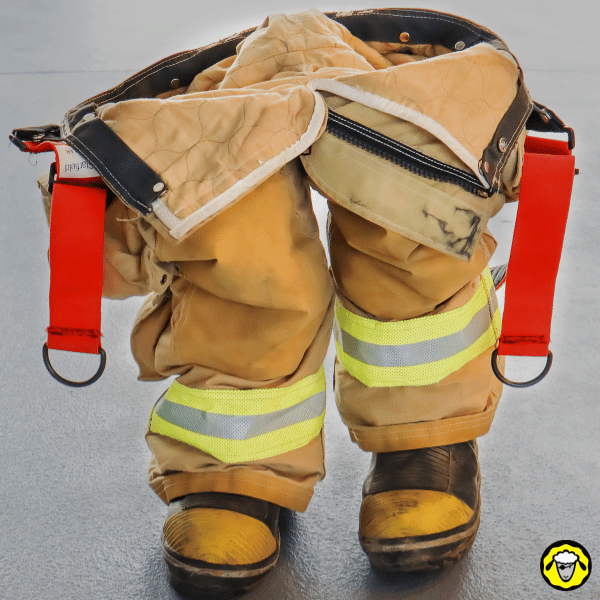
A firefighter's pants. The pockets are already equipped with useful gear. The “change of pants” is the civilian version of this "always ready" logic.
Latest publications: read them to stay ahead of the curve.

Download your free PDF guide now!
Little-known tips who could possibly save the day. A guide essential pour get off to a good start... and avoid costly mistakes.












Cool pants, dude!
Those are nice pants